Dubai vs Global Gateway Cities: A Comparative Analysis of Yield and Volatility
Global real estate investors often compare Dubai with established gateway cities like London, New York, Singapore, Hong Kong, and Sydney. The key debate is simple:
Should investors prioritize higher rental yield markets with growth volatility (like Dubai) or lower yield but historically stable capital cities (like global gateway hubs)?
Dubai has rapidly positioned itself as a high-performing investment destination, offering attractive income potential, while global gateway cities are traditionally seen as capital preservation markets with lower income returns.
Understanding the Investment Lens: Yield vs Volatility
Real estate performance is typically evaluated using two core metrics:
- Rental Yield → annual rental income as a percentage of property value
- Volatility (Risk) → how much property prices fluctuate over time
Dubai stands out for high yields and moderate volatility, while global gateway cities usually offer low yields and relatively stable long-term appreciation.
Dubai Real Estate: High Yield Growth Market
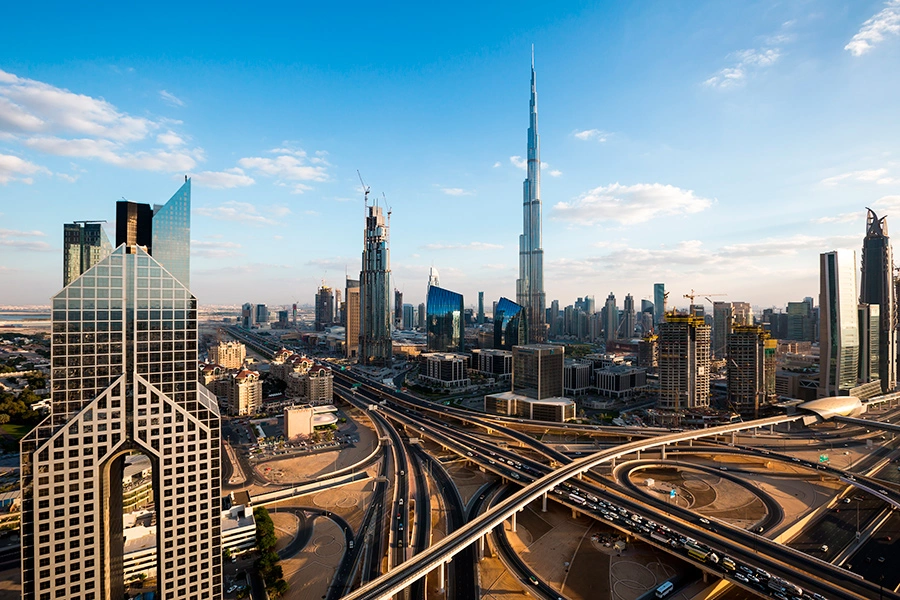
Dubai has emerged as one of the most attractive real estate markets globally due to strong rental returns and investor-friendly conditions.
Key Yield Performance
- Average rental yield in Dubai (2025): 6.88% overall
- Apartments can reach up to: 7.3%+ yield
- Villas average around: 5.0% yield
Compared to global cities where residential yields often stay below 4%, Dubai clearly leads in income generation.
Core Strengths of Dubai
Dubai’s investment appeal is driven by structural advantages:
- Tax-free income environment (no property tax or capital gains tax)
- Rapid population growth supporting rental demand
- Strong tourism-driven short-term rental market
- Competitive entry prices compared to global capitals
- Flexible ownership rules for international investors
- Strong infrastructure and continuous mega-development projects
These factors create a market where cash flow performance is a primary attraction, not just long-term appreciation.
Volatility Profile
While returns are strong, Dubai is not without fluctuations:
- Periodic supply-driven corrections
- Sensitivity to global investor sentiment
- Short-term price adjustments during geopolitical or economic shifts
Recent market analysis shows that while Dubai remains resilient, short-term volatility can be higher than traditional gateway cities due to rapid supply cycles and speculative investment phases.
Global Gateway Cities: Stability-Driven Markets

Cities like London, New York, Singapore, and Hong Kong follow a different investment pattern.
Yield Characteristics
- Typical rental yields: 2%–4%
- High property values compress income returns
- Strong reliance on capital appreciation rather than cash flow
These markets are generally income-light but value-stable.
Strengths of Gateway Cities
- Deep institutional investor participation
- Highly regulated and transparent markets
- Strong global demand for prime assets
- Long-term capital preservation reputation
- Stable legal and financial systems
They are often seen as “wealth storage markets” rather than income-generating assets.
Volatility Profile
Gateway cities typically show:
- Lower short-term price swings
- Slower but steadier appreciation cycles
- Strong resilience during global downturns
- High liquidity in prime districts
However, affordability constraints and regulatory pressures can sometimes limit upside potential.
Dubai vs Global Gateway Cities: Direct Comparison
| Factor | Dubai | Global Gateway Cities |
|---|---|---|
| Average Rental Yield | 5%–7%+ | 2%–4% |
| Capital Appreciation | Moderate to high (cyclical) | Stable, long-term |
| Volatility | Medium–High | Low–Medium |
| Taxation | 0% property & income tax | High taxes in most cities |
| Liquidity | High but cyclical | Very high & stable |
| Investor Type | Yield-seeking investors | Wealth preservation investors |
| Market Behavior | Growth + cycles | Stability + maturity |
Risk & Return Interpretation

Dubai Profile
Dubai behaves like a high-yield emerging global hub:
- Strong rental income
- Faster cycles of boom and correction
- Attractive for income-focused investors
Gateway Cities Profile
These cities function as low-yield financial safe havens:
- Stable pricing trends
- Lower income but consistent demand
- Suitable for long-term capital security
Investor Perspective: What Matters More?
The choice depends on strategy:
Choose Dubai if you want:
- Higher rental income
- Tax efficiency
- Faster ROI cycles
- Exposure to a rapidly growing global city
Choose Global Gateway Cities if you want:
- Lower risk exposure
- Stable capital preservation
- Long-term institutional-grade security
- Predictable but lower returns
FAQs
Is Dubai real estate more profitable than London or New York?
Yes in terms of rental yield, Dubai generally outperforms global gateway cities, often delivering 2–3x higher rental returns.
Why are Dubai yields higher than global cities?
Because property prices are relatively more affordable while rental demand is strong due to population growth and tourism.
Is Dubai real estate risky?
It carries moderate volatility risk, mainly due to supply cycles and global investor sentiment, but is supported by strong fundamentals.
Which is safer: Dubai or global gateway cities?
Global gateway cities are typically more stable, but Dubai offers stronger income potential with slightly higher volatility.
Can Dubai be considered a long-term investment market?
Yes. With strong infrastructure, population growth, and investor-friendly policies, Dubai is increasingly viewed as a long-term global investment hub, not just a speculative market.
Conclusion
Dubai and global gateway cities represent two different investment philosophies:
- Dubai = High yield, dynamic growth, moderate volatility
- Global cities = Low yield, stable capital preservation
For investors, the decision is not about which is better universally—but which aligns with their risk appetite, income expectations, and investment horizon.
Source : Gulf News